

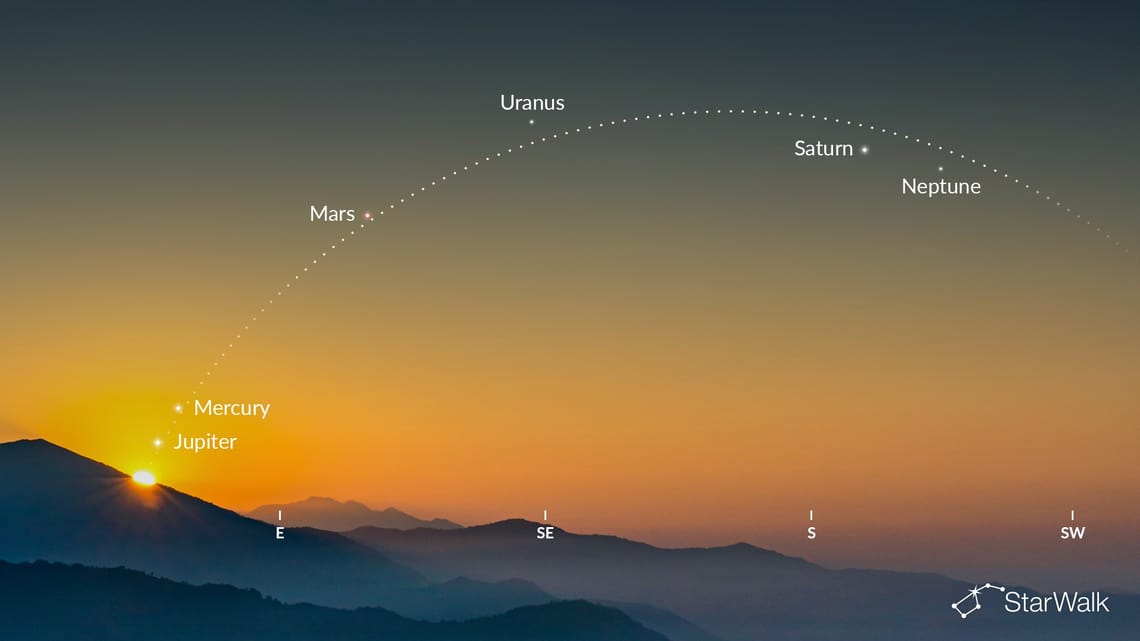
On Wednesday, August 12, 2026, six planets, Jupiter, Mercury, Mars, Uranus, Saturn, and Neptune, will appear in the morning sky before sunrise in a planetary parade.
Usually, people can look up at the sky and spot at least one planet. Two or three planets are also commonly hanging out in the night sky, according to NASA. But what about when four, five or even six planets are visible?
When that happens, it can be referred to as a “planetary parade,” or the technical term, planetary alignment. The planets can appear to be marching across the sky in a straight line.
But this doesn’t mean all six will be easy to see with the naked eye. Mars and Saturn will be the easiest targets, Mercury will be low but possible to catch with a clear horizon, Jupiter will sit even lower than Mercury, Uranus will require binoculars, and Neptune will need a telescope. Mercury and Jupiter’s view can be obstructed if the horizon isn’t clear.
The phenomena will be visible across the globe, in both the Northern and Southern hemispheres.
The main date for the planetary parade is Wednesday, August 12th. It will be visible in the United States on that date in the early morning hours. But it may also be visible in other parts of the world on Tuesday, August 11th and also on Thursday, August 13th. The day that will provide the best viewing depends on where spectators are located and the time the sun begins to rise.
When trying to see the planets in the coming days, it’s recommended that you get up early, before sunrise. Astronomers are predicting that the best viewing time for the Eastern U.S. will be around 6:15am.
Be at the stargazing location ready to see the planets at least 45 minutes before the sun rises. Find a spot with a clear, unobstructed view of the eastern and southern horizon. Steer clear of light pollution and move away from cities. Have your binoculars or telescope ready to view planets that aren’t visible to the naked eye. You can even choose to use stargazing apps like Stellarium or SkySafari.