


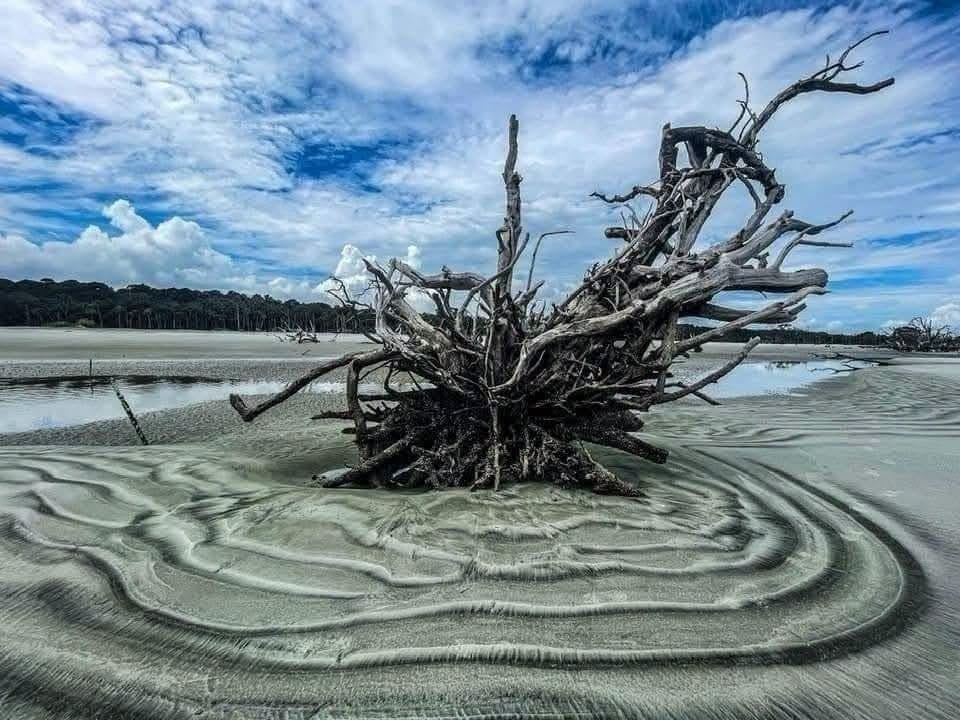
On Wednesday, Hunting Island State Park Manager, Kirby Brady, informed everyone in a release that the south end boneyard is temporarily closed due to the king tides this week.
“I am reaching out to inform you that due to recent high tides, Little Hunting Island/Boneyard Beach will be temporarily closed due to the safety of the bridge leading to the area. This is the beach located by the Nature Center,” Brady said in a post on the Friends of Hunting Island State Park Facebook page.
“Tides have been higher than normal and are expected to remain elevated through the remainder of the week. The increased water levels have created a large drop-off at the end of the bridge near the beach access. There is also a safety concern for guests who access the beach at low tide and may be unable to safely return to the bridge as the tide rises,” Brady added.
“For these reasons, the bridge will remain temporarily closed for the rest of the week.”
Additional precautions are being taken by park staff as well.
“The beginning of the bridge will be cross-boarded and posted with signage indicating the closure. An advisory will also be posted on our website.”
Expectations are that it will be closed through the end of the week, as the king tides will be around through Thursday night.
“We will continue to monitor the area throughout the week. Thank you for your understanding and cooperation as we work to ensure the safety of our visitors,” Brady said.
Commonly referred to as the south beach boneyard, Little Hunting Island boneyard beach is a stunning, otherworldly stretch of coastline located at the southern end of Hunting Island State Park. It’s undergoing some of the most aggressive coastal erosion on the U.S. East Coast, losing up to an astonishing 25 to 30 feet of shoreline per year. This massive loss of land has completely reshaped the barrier island over the past few decades.
One of the most photographed locations at Hunting Island State Park, the iconic boneyard beach is the direct byproduct of this destruction.
As saltwater encroaches, it poisons the root systems of live oaks, slash pines, and palmettos. Once dead, these trees are bleached by the sun and weathered by the tides, leaving behind an eerie, sculptural graveyard of skeletal remains embedded right in the sand.
The boneyard beach is an icon. Let’s hope that this week’s tides take it easy on her.