

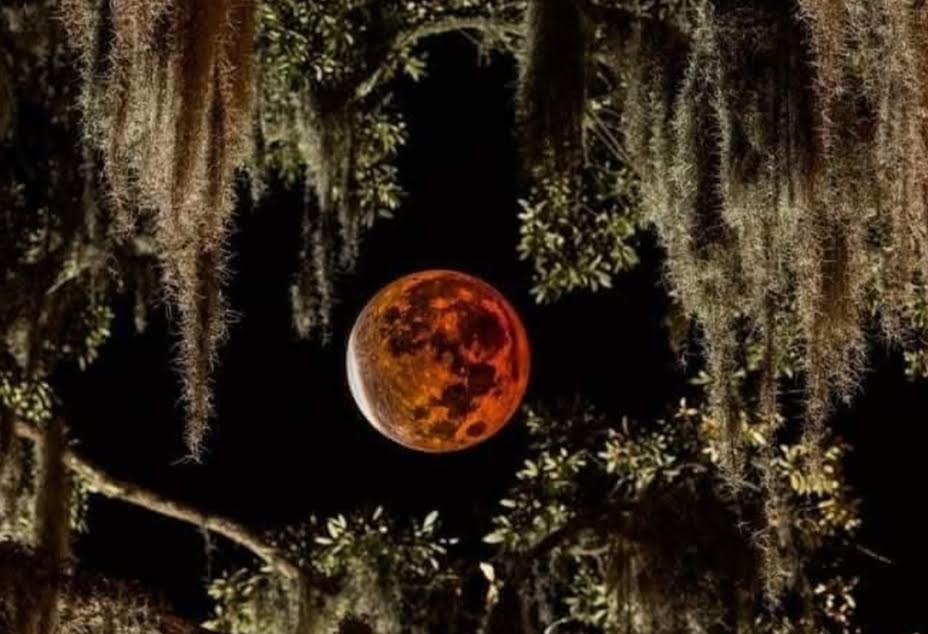
Get ready for another celestial event in the sky over Beaufort, SC. The August 2026 full moon, known as the sturgeon moon, will reach its peak very early in the morning on Friday, August 28th, and will also feature a near-total lunar eclipse, also known as a blood moon.
The Sturgeon Moon will reach peak illumination on Friday, August 28, at 12:18 a.m. ET, according to Space.com. This year’s full moon will also coincide with a partial lunar eclipse, beginning late Thursday night and continuing into the early morning hours of Friday
The best views of the eclipse will be in the eastern United States and Canada and across Central and South America. Those in the western U.S. will still be able to see part of the eclipse.
We’re more fortunate here. With the low level of ground light here in Beaufort, SC, it’s always a great spot for stargazing.
The best time to begin watching the eclipse is around 10:33 p.m. on Thursday night, with the greatest coverage occurring around 12:12 a.m. on Friday morning. The eclipse will end just after 3 a.m. ET.
Unlike a solar eclipse, no special glasses are needed to view a lunar eclipse, and binoculars or a telescope can provide an enhanced view.
The Old Farmer’s Almanac, which has been naming full moons since the 1930s, explains that the August full moon is called the sturgeon moon because the giant lake sturgeon, a native freshwater fish of the Great Lakes and Lake Champlain, was historically abundant during this time of year.
The fish was an important food source for Native Americans who lived in the region.
The August full moon is also known by other names associated with the season, including the corn moon, harvest moon and rising moon.
The moon will pass into the shadow of Earth, creating a deep partial eclipse. At the moment of greatest eclipse, 96.3% of the Moon’s disk is within Earth’s umbra, the central part of the shadow where the Sun is completely blocked by Earth. This part of the eclipse is visible and is what we will see in our sky.
The penumbra is the part of Earth’s shadow where the Sun is only partially covered by Earth. The effect of the penumbra on the Moon’s appearance is subtle. But after the partial phase begins, at 10:34 p.m., the umbra’s dramatic effect is easily visible as it takes an increasingly large bite out of the disk of the full moon.
Less than an hour later, the part of the moon still in sunlight will be small enough for observers’ eyes to adapt to darkness and perceive the coppery color of the part of the moon within the umbra.
Also, as a bit of a bonus, Saturn will appear as a bright golden point near the moon during the eclipse, visible across our area.