

It’s late August and the fall Atlantic sturgeon spawning run is well underway in South Carolina. Returning adults are making their way far up the rivers to produce next year’s class of sturgeon.
During spawning, females release eggs into the water that are fertilized by males. The eggs develop a sticky coating so they can adhere to the bottom until they hatch. After several days, yolk sac larvae emerge that look like little tadpoles. These larvae are only about 1/4” long and hide along the river’s bottom. Then, they begin to drift downstream until they reach our estuaries.
The little sturgeon grow quickly during this time to (hopefully) avoid being eaten by larger fish. They’ll begin feeding on small, bottom-dwelling invertebrates found on the riverbeds.
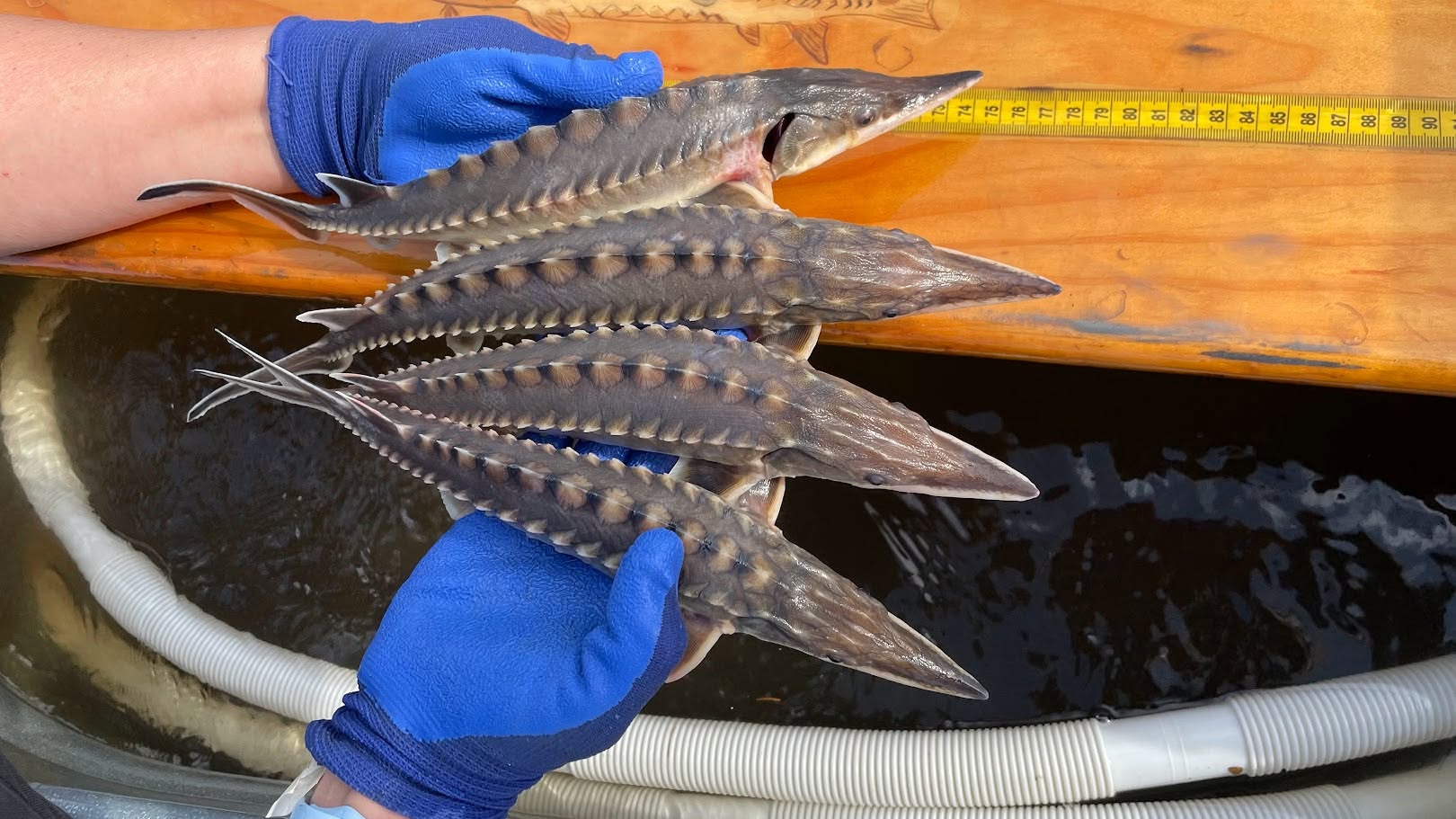
When they reach their first birthday, they will be about 1 ft long. At this size their scutes, or scales, are razor-sharp and act as armor against predators. Their snouts also become more pointed which is where the Atlantic sturgeon gets it’s scientific name “oxyrhinchus” meaning “sharp snout.
“This inaugural South Carolina Sturgeon Awareness Month has been a great one and we need your help to continue protecting our state’s sturgeon! Please report sightings of stranded and dead sturgeon: dnr.sc.gov/marine/sturgeon/index.html
This allows scientists to collect samples and data to better understand sturgeon populations, track recovery efforts, identify threats to the species, and fill in gaps in our knowledge to help protect our Atlantic and shortnose sturgeon.
Known to live to be over 60 years old, grow to 14 feet in length and weigh up to 800 pounds, the sturgeon is indeed a prehistoric species. They appear in the fossil record more than 200 million years ago and are commonly referred to as ‘a living fossil’.
A century ago, in the late 1890s, there was a huge fishery for sturgeon all over the East Coast revolving around harvesting of the eggs for caviar. It was so popular, it was dubbed ‘The Black Gold Rush’.
According to NOAA Fisheries, Atlantic sturgeon were once found in great abundance, but their populations have declined greatly due to over-fishing and habitat loss. Atlantic sturgeon were prized for their eggs, which were valued as high-quality caviar. During the late 1800s, people flocked to the Eastern United States in search of caviar riches from the sturgeon fishery.
By the beginning of the 1900s, sturgeon populations had declined drastically. Close to 7 million pounds of sturgeon were reportedly caught in 1887, but by 1905 the catch declined to only 20,000 pounds. By 1989 only 400 pounds of sturgeon were recorded.
Sturgeon are born in the freshwater or brackish water estuaries along the SC coast, particularly in the Edisto, Savannah and Pee Dee Rivers, and head to the ocean after a few years to mature. Atlantic sturgeon are the largest fish living in freshwater on the entire Atlantic coast.
During the mid-1970s, half of the US landings of Atlantic sturgeon came from South Carolina. The sturgeon fishery in South Carolina was officially closed in 1985
Today, all five U.S. Atlantic sturgeon population segments are listed as endangered under the Endangered Species Act.