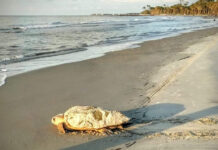



Some folks walking along the beach at Fripp Island were in for a surprise on Sunday when a bizarre looking prehistoric fish washed ashore. The rare Atlantic sturgeon was found on Sunday by Fripp resident Pete Sload, and a photo that he took of it was posted on Facebook.
A sturgeon washing up on a beach is pretty rare because sturgeon are pretty rare.
They are quite rare indeed. To see this one washed ashore must have been a sight for folks on Fripp Island. One also washed up along the shore on Hilton Head Island back in November.
Known to live to be over 60 years old, grow to 14 feet in length and weigh up to 800 pounds, the sturgeon is indeed a prehistoric species. They appear in the fossil record more than 200 million years ago and are commonly referred to as ‘a living fossil’.
The Facebook post said that Pete promptly reported it to the South Carolina Department of Natural Resources (DNR) via email, and included a photo. DNR sent a staff member the following day to retrieve the fish.
A century ago, in the late 1890s, there was a huge fishery for sturgeon all over the East Coast revolving around harvesting of the eggs for caviar. It was so popular, it was dubbed ‘The Black Gold Rush’.
According to NOAA Fisheries, Atlantic sturgeon were once found in great abundance, but their populations have declined greatly due to over-fishing and habitat loss. Atlantic sturgeon were prized for their eggs, which were valued as high-quality caviar. During the late 1800s, people flocked to the Eastern United States in search of caviar riches from the sturgeon fishery.
By the beginning of the 1900s, sturgeon populations had declined drastically. Close to 7 million pounds of sturgeon were reportedly caught in 1887, but by 1905 the catch declined to only 20,000 pounds. By 1989 only 400 pounds of sturgeon were recorded.
Sturgeon are born in the freshwater or brackish water estuaries along the SC coast, particularly in the Edisto, Savannah and Pee Dee Rivers, and head to the ocean after a few years to mature. Atlantic sturgeon are the largest fish living in freshwater on the entire Atlantic coast.
During the mid-1970s, half of the US landings of Atlantic sturgeon came from South Carolina. The sturgeon fishery in South Carolina was officially closed in 1985
Today, all five U.S. Atlantic sturgeon population segments are listed as endangered under the Endangered Species Act.
You’ve heard the term, “a dinosaur washed up on the beach.” This Atlantic sturgeon on Fripp Island is the real deal.
Want even more? Download the FREE Newsbreak app and see more Beaufort stuff from Explore Beaufort.