

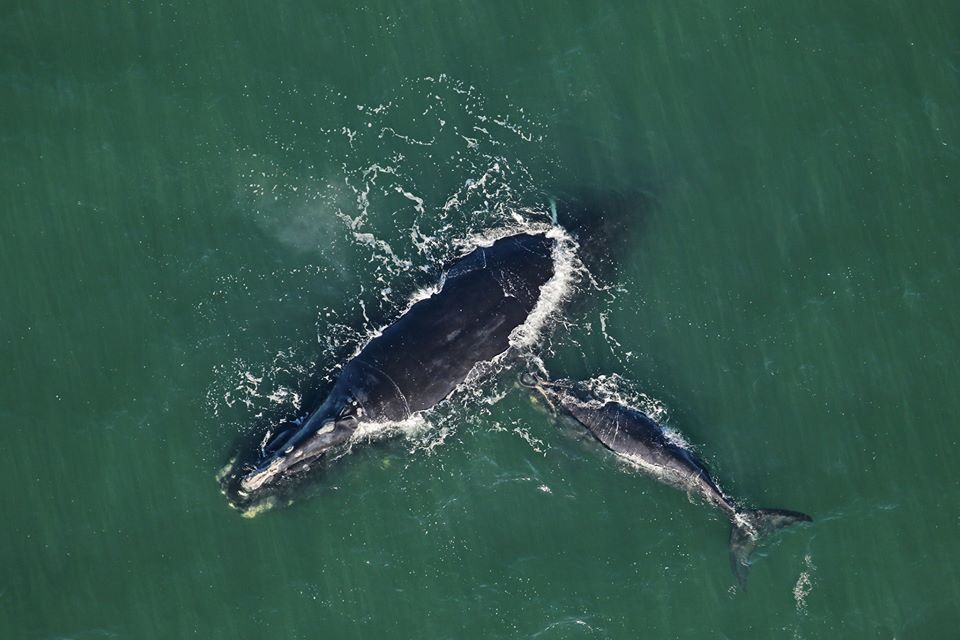
According to a recent article by AP News, North Atlantic Right Whales have shown a trend of slow population growth over the past 4 years. One of the rarest whales on the planet has continued an encouraging trend of population growth in the wake of new efforts to protect the giant animals, according to scientists who study them.
According to the report, the North Atlantic right whale now numbers an estimated 384 animals, up eight whales from the previous year, according to a report by the North Atlantic Right Whale Consortium released Tuesday. The whales have shown a trend of slow population growth over the past four years and have gained more than 7% of their 2020 population, the consortium said.
It’s a welcome development in the wake of a troubling decline in the previous decade. The population of the whales, which are vulnerable to collisions with ships and entanglement in fishing gear, fell about 25% from 2010 to 2020.
New management measures in Canada that attempt to keep the whales safe amid their increased presence in the Gulf of St. Lawrence have been especially important.
Scientists have cautioned in recent years that the whale’s slow recovery is happening at a time when the giant animals still face threats from accidental deaths, and that stronger conservation measures are needed. But there are also reasons to believe the whales are turning a corner in terms of low reproduction numbers.
The whales are less likely to reproduce when they have suffered injuries or are underfed, scientists have said. That has emerged as a problem for the whale because they aren’t producing enough babies to sustain their population, they’ve said.
However, this year four mother whales had calves for the first time, Hamilton said. And some other, established mother whales had shorter intervals between calves, he said.
In total, 11 calves were born, which is less than researchers had hoped for, but the entry of new females into the reproductive pool is encouraging, Hamilton said.
And any number of calves is helpful in a year of no mortalities.
The slight increase in the population estimate, coupled with no detected mortalities and fewer detected injuries than in the last several years, leaves us cautiously optimistic about the future of North Atlantic right whales.
What we’ve seen before is this population can turn on a dime.
The whales were hunted to the brink of extinction during the era of commercial whaling. They have been federally protected for decades.
The whales migrate every year from calving grounds off Florida and Georgia to feeding grounds off New England and Canada. Some scientists have said the warming of the ocean has made that journey more dangerous because the whales have had to stray from established protected areas in search of food.
The article quoted Gib Brogan, senior campaign director with Oceana, as saying, “Continued attacks on the Marine Mammal Protection Act and efforts to weaken NOAA’s science-based safeguards put this fragile population at even greater risk. We need Congress to uphold, not undermine, the laws, programs, and experts that give North Atlantic right whales a fighting chance for continued survival,”
Here in the Beaufort, SC area and all along the South Carolina coast, right whale season is fast approaching. The first whales are typically seen in November as they make their way south along the coast to warmer water in the winter time. They are then seen again in late winter/early spring making their way back north along the coast.
Right whales endangered
The NOAA Fisheries reports that the North Atlantic right whale is one of the world’s most endangered large whale species, with less than 400 whales remaining. Right whales are baleen whales, feeding on shrimp-like krill and small fish by straining huge volumes of ocean water through their baleen plates, which act like a sieve.
By the early 1890s, commercial whalers had hunted right whales in the Atlantic to the brink of extinction. Whaling is no longer a threat, but human interactions still present the greatest danger to this species. Entanglement in fishing gear and vessel strikes are among the leading causes of North Atlantic right whale mortality.
According to the NOAA, there were only 94 breeding female right whales as of February 2018. Only 5 calves were born during that same period.
According to an NOAA report, “an encounter with fishing gear is the most frequent cause of documented right whale serious injuries and deaths in recent years.” For the 19 recent whale deaths, NOAA could determine a cause of death for 10. And of those 10 fatalities, five were caused by ship strikes and five were caused by entanglement in fishing gear.
One study cited by NOAA showed that nearly 85 percent of right whales have been entangled in fishing gear. For 59 percent of right whales, it has happened twice. And the number of entanglements has been trending upward.
A dwindling population
The NOAA says right whales, like other large whales, live for a long time and can breed multiple times over a lifetime. That makes them resilient. But the memo also points out the obvious fact that if a species fails to replace its dead with new births over time, it will have a difficult time recovering a dwindling population.
So reproduction – or rather, a lack of reproduction – is a major area of concern for researchers. And for reproduction, healthy mothers are required. According to NOAA, right whales now have greater distances to travel from their feeding grounds, which have shifted farther north, down to the areas off the coasts of South Carolina Florida and Georgia where their calving grounds are.
People who spot a right whale should also call 1-877-WHALE-HELP so NOAA can alert other ships in the area.