

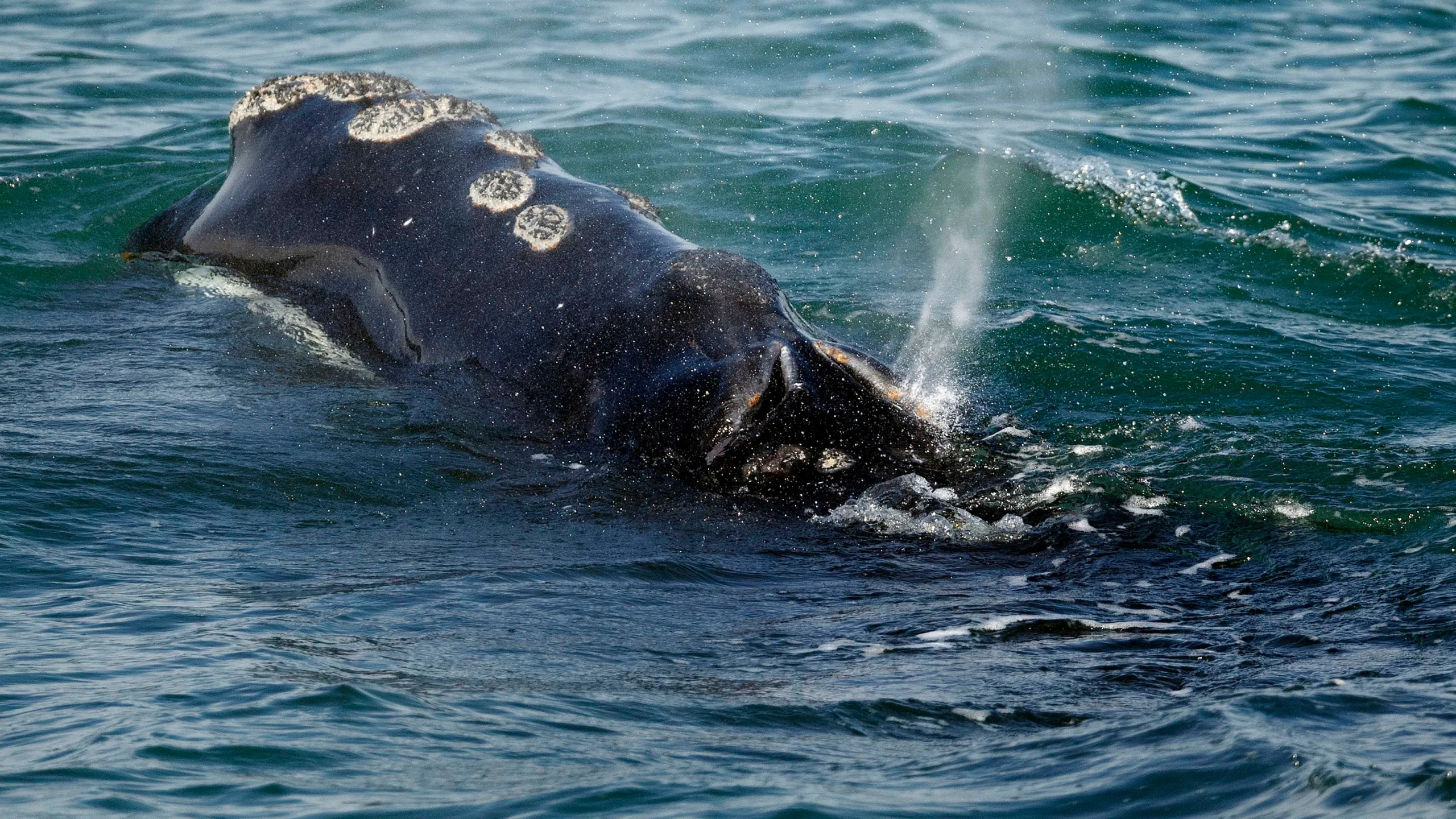
The first North Atlantic right whale calf of the season was spotted off the South Carolina coast last weekend, according to the Lowcountry Marine Mammal Network.
The North Atlantic right whale is one of the world’s most endangered mammals, with approximately less than 400 remaining. Each winter, the whales migrate from feeding grounds in New England to the warmer waters off Georgia, South Carolina and Florida, the only known calving grounds for the species.
This sighting is significant because for this endangered species, every calf counts, said Gib Brogan of the U.S. chapter of conservation group Oceana.
NOAA surveys to spot the endangered mammal have not started yet, but will in the coming weeks.
The waters off the coasts of South Carolina, Georgia, and Florida, including near Beaufort, serve as a vital nursery area, providing a warm, protected habitat for newborn calves.
Right whales endangered
The NOAA Fisheries reports that the North Atlantic right whale is one of the world’s most endangered large whale species, with an estimated less than 400 whales remaining, and fewer than 70 are reproductively active females. Right whales are baleen whales, feeding on shrimp-like krill and small fish by straining huge volumes of ocean water through their baleen plates, which act like a sieve.
By the early 1890s, commercial whalers had hunted right whales in the Atlantic to the brink of extinction. Whaling is no longer a threat, but human interactions still present the greatest danger to this species. Entanglement in fishing gear and vessel strikes are among the leading causes of North Atlantic right whale mortality.
“There were only 94 breeding female right whales as of February 2018, and you don’t have to be Einstein to figure out that’s a bad situation,” said Barb Zoodsma of the NOAA Fisheries said.
On top of a lack of births, the right whale population has experienced an unsettling number of deaths. A technical memorandum issued by NOAA in September 2018 said that 19 right whales had died in 2017 and 2018.
Only 5 calves were born during that same period.
According to that same NOAA report, “an encounter with fishing gear is the most frequent cause of documented right whale serious injuries and deaths in recent years.” For the 19 recent whale deaths, NOAA could determine a cause of death for 10. And of those 10 fatalities, five were caused by ship strikes and five were caused by entanglement in fishing gear.
One study cited by NOAA showed that nearly 85 percent of right whales have been entangled in fishing gear. For 59 percent of right whales, it has happened twice. And the number of entanglements has been trending upward.
A dwindling population
The NOAA memorandum says right whales, like other large whales, live for a long time and can breed multiple times over a lifetime. That makes them resilient. But the memo also points out the obvious fact that if a species fails to replace its dead with new births over time, it will have a difficult time recovering a dwindling population.
So reproduction – or rather, a lack of reproduction – is a major area of concern for researchers. And for reproduction, healthy mothers are required. According to NOAA, right whales now have greater distances to travel from their feeding grounds, which have shifted farther north, down to the areas off the coasts of South Carolina Florida and Georgia where their calving grounds are.
Whether you’re along the S.C. coast or Georgia or Florida, people who spot a right whale should also call 1-877-WHALE-HELP so NOAA can alert other ships in the area.
READ: From brink of extinction: Atlantic Humpback whale population back to normal