

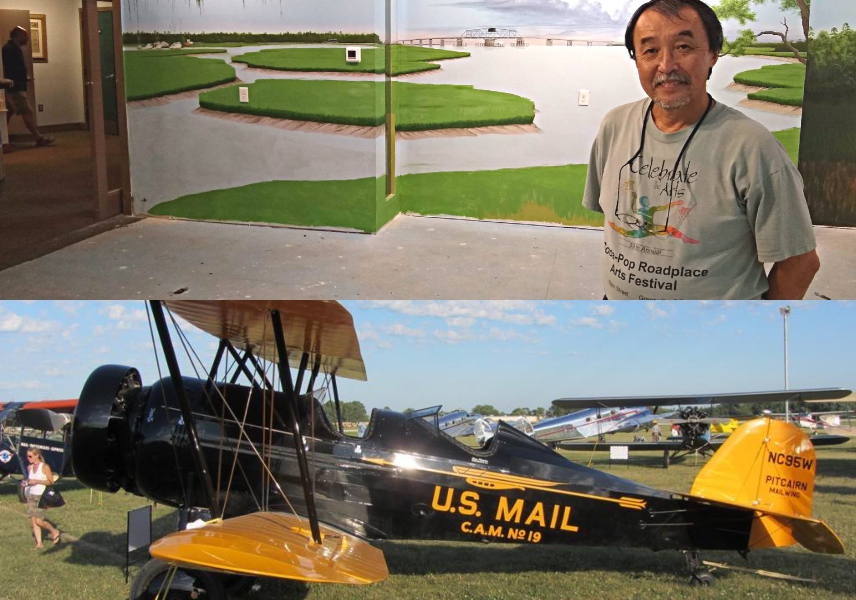
After helping transform the Hunting Island Visitor Center in 2020 by painting a complete surround mural depicting the various ecologies of the island, local artist Aki Kato has again been commissioned to add yet another image and more art to the mural at the Visitor Center.
Kato, who has spent his whole life working as an artist, has been asked to add an image of a 100 year old yellow and black Pitcairn Sport Mailwing biplane, a two-passenger version of the Pitcairn Mailwing airplane that was in use to deliver mail over long distances some 100 years ago.
Why? Well, this story is little-known to people, and it’s a very interesting story to be heard, because the plane landed on the beach when it ran out of fuel back in 1929.
The interesting story behind it, as told by Hunting Island’s Lighthouse Director, Ted Panayotoff:
On the evening of December 23, 1929, Hunting Island Lighthouse Principal Keeper, Theodore Gaillard and his two Assistant Keepers were surprised when an aircraft landed on the beach in front of the lighthouse.
The aircraft, which was headed south, landed close to the water where the beach is hard and smooth and then probably taxied to the right to be above the high-water mark. The aircraft was a yellow and black Pitcairn Sport Mailwing biplane, a two-passenger version of the Pitcairn Mailwing airplane developed by the Pitcairn Aircraft Company of Willow Grove, Pennsylvania for the U.S. Postal Service.
The aircraft, produced from 1927 t0 1931 in its air mail version, could fly up to 550 pounds of air-mail overnight along air-mail routes at a maximum speed of 150 mph for a range of 520 miles. These lighted air-mail routes, developed by the U. S. Bureau of Lighthouses for the U. S. Postal Service, facilitated the overnight delivery of air-mail.
The pilot of the aircraft (there were no passengers) was Mr. John Wolf of Pennsylvania, an employee of the Lycoming Mfg. Company, that manufactured aircraft engines and still does in Williamsport, PA. He was enroute from Williamsport, PA to Clearwater, Florida. He was running low on fuel and chose to land at the lighthouse.
At this time, before the establishment of inland air-mail routes lighted by beacons developed by the U. S. Bureau of Lighthouses, pilots often chose to fly near the coast where existing lighthouses provided aids to navigation as night approached. Mr. Wolf was getting low on gas so he chose to land on the beach at the Hunting Island Lighthouse as the day ended.
The next morning, Christmas Eve, after being the guest of Keeper Gaillard overnight, Mr. Wolf was provided additional fuel for his airplane from the supply at the light station for the station’s gasoline engine powered boat. Mr. Wolf departed the Hunting Island Lighthouse at 10:30 that morning to complete his flight to Clearwater, FL.
Keeper Gaillard, on December 24th , sent a full report of the incident to the Superintendent of the 6th Lighthouse District, Mr. Henry Beck, in Charleston, SC. The information was forwarded to the Bureau of Lighthouses in Washington, D.C. This resulted in a Letter of Commendation sent to keeper Gaillard on December 31, 1929. Although commendations to lighthouse keepers for assistance to mariners were not uncommon, this commendation for assistance to a pilot of an aircraft was possibly unique.
Well done to Keeper Gaillard! Later, after retiring as a Lighthouse Keeper in 1942, Keeper Gaillard and his wife Ellen moved to Beaufort. They owned a small farm north of Beaufort off Rt-21, north of the present Marine Corps Air Station. When they passed away, they were buried in the cemetery of the St. Helena Church in downtown Beaufort. There their grave site is marked by special markers of the U.S. Lighthouse Service and the U.S. Coast Guard.
To give it some attention, we have commisioned Studio Aki to add this image to the Mural in the Hunting Island Visitor Center.
Here is the completed mural addition. Make sure to check it out at the Visitor Center.
For more information about Friends of Hunting Island, and all of the wonderful things that they do, visit them here.